OCV Fitting#
Open-circuit voltage fitting is the key step for conducting Degradation Mode Analysis (DMA). PyProBE has a number of built-in methods for this.
%%capture
%pip install matplotlib
import matplotlib.pyplot as plt
import numpy as np
import polars as pl

import pyprobe
from pyprobe.analysis import degradation_mode_analysis as dma

%matplotlib inline
In this example, we are going to generate a synthetic aged OCV curve. We will use the half cell OCV fits from Chen 2020 [1].
def graphite_LGM50_ocp_Chen2020(sto):
    """Chen2020 graphite ocp fit."""
    u_eq = (
        1.9793 * np.exp(-39.3631 * sto)
        + 0.2482
        - 0.0909 * np.tanh(29.8538 * (sto - 0.1234))
        - 0.04478 * np.tanh(14.9159 * (sto - 0.2769))
        - 0.0205 * np.tanh(30.4444 * (sto - 0.6103))
    )

    return u_eq


def nmc_LGM50_ocp_Chen2020(sto):
    """Chen2020 nmc ocp fit."""
    u_eq = (
        -0.8090 * sto
        + 4.4875
        - 0.0428 * np.tanh(18.5138 * (sto - 0.5542))
        - 17.7326 * np.tanh(15.7890 * (sto - 0.3117))
        + 17.5842 * np.tanh(15.9308 * (sto - 0.3120))
    )

    return u_eq


z = np.linspace(0, 1, 1000)  # stoichiometry vector

# generate complete ocp curves
ocp_pe = nmc_LGM50_ocp_Chen2020(z)
ocp_ne = graphite_LGM50_ocp_Chen2020(z)
We will now define a set of stoichiometry limits to generate our synthetic OCV curve:
n_pts = 1000
# positive electrode
x_pe_lo = 0.85  # stoichiometry at low cell SOC
x_pe_hi = 0.27  # stoichiometry at high cell SOC
x_pe = np.linspace(x_pe_lo, x_pe_hi, n_pts)  # stoichiometry range

# negative electrode
x_ne_lo = 0.03  # stoichiometry at low cell SOC
x_ne_hi = 0.9  # stoichiometry at high cell SOC
x_ne = np.linspace(x_ne_lo, x_ne_hi, n_pts)  # stoichiometry range

# full cell voltage and capacity
voltage = nmc_LGM50_ocp_Chen2020(x_pe) - graphite_LGM50_ocp_Chen2020(x_ne)
capacity = np.linspace(0, 5, n_pts)  # capacity range in Ah

plt.figure()
plt.plot(capacity, voltage)
plt.xlabel("Capacity (Ah)")
plt.ylabel("Voltage (V)")
Text(0, 0.5, 'Voltage (V)')
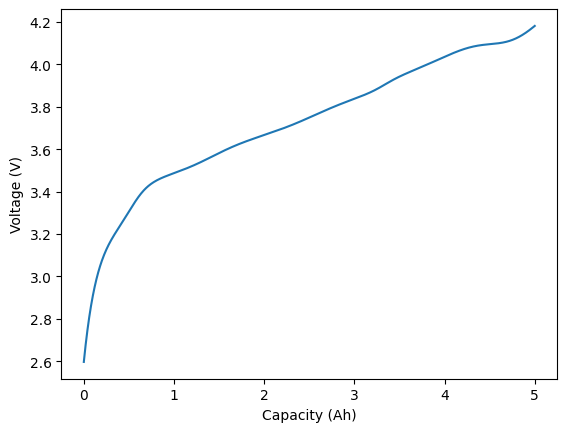
We will now generate a fit to this voltage curve.
First, we must create instances of the OCP class to hold our electrode OCP information:
neg_ocp = dma.OCP(graphite_LGM50_ocp_Chen2020)
pos_ocp = dma.OCP(nmc_LGM50_ocp_Chen2020)
In this example, we have directly declared the OCPs since we already have callable functions for them. Alternatively you can use the from_data or from_expression to define your OCP from data points or a Sympy expression.
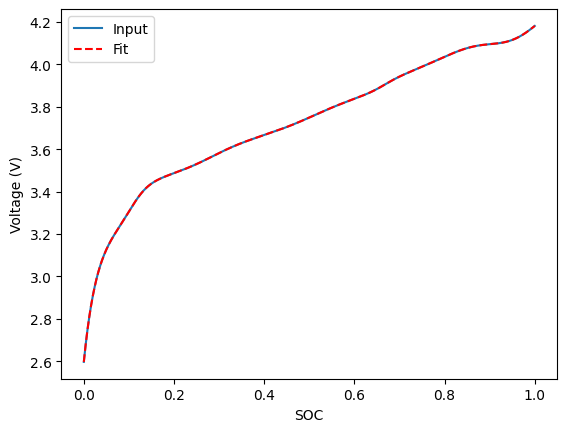
Now we can fit to the ocv curve:
# put the voltage and capacity data into a Result object (not necessary in normal use)
OCV_result = pyprobe.Result(
    lf=pl.DataFrame({"Capacity [Ah]": capacity, "Voltage [V]": voltage}),
    info={},
)

stoichiometry_limits, fitted_curve = dma.run_ocv_curve_fit(
    input_data=OCV_result,
    ocp_ne=neg_ocp,
    ocp_pe=pos_ocp,
    fitting_target="OCV",
    optimizer="minimize",
    optimizer_options={
        "x0": np.array([0.9, 0.1, 0.1, 0.9]),
        "bounds": [(0, 1), (0, 1), (0, 1), (0, 1)],
    },
)
This produces two result objects. The first is the fitted stoichiometry limits:
print(stoichiometry_limits.data)
shape: (1, 8)
┌────────────┬────────────┬────────────┬───────────┬───────────┬───────────┬───────────┬───────────┐
│ x_pe low   ┆ x_pe high  ┆ x_ne low   ┆ x_ne high ┆ Cell      ┆ Cathode   ┆ Anode     ┆ Li        │
│ SOC        ┆ SOC        ┆ SOC        ┆ SOC       ┆ Capacity  ┆ Capacity  ┆ Capacity  ┆ Inventory │
│ ---        ┆ ---        ┆ ---        ┆ ---       ┆ [Ah]      ┆ [Ah]      ┆ [Ah]      ┆ [Ah]      │
│ f64        ┆ f64        ┆ f64        ┆ f64       ┆ ---       ┆ ---       ┆ ---       ┆ ---       │
│            ┆            ┆            ┆           ┆ f64       ┆ f64       ┆ f64       ┆ f64       │
╞════════════╪════════════╪════════════╪═══════════╪═══════════╪═══════════╪═══════════╪═══════════╡
│ 0.85       ┆ 0.27       ┆ 0.03       ┆ 0.9       ┆ 5.0       ┆ 8.62069   ┆ 5.747127  ┆ 7.5       │
└────────────┴────────────┴────────────┴───────────┴───────────┴───────────┴───────────┴───────────┘
And the second is a result object containing the fitted OCP curve:
fig, ax = plt.subplots()
fitted_curve.plot(x="SOC", y="Input Voltage [V]", ax=ax, label="Input")
fitted_curve.plot(
    x="SOC",
    y="Fitted Voltage [V]",
    ax=ax,
    color="red",
    label="Fit",
    linestyle="--",
)
ax.set_ylabel("Voltage (V)")
Text(0, 0.5, 'Voltage (V)')
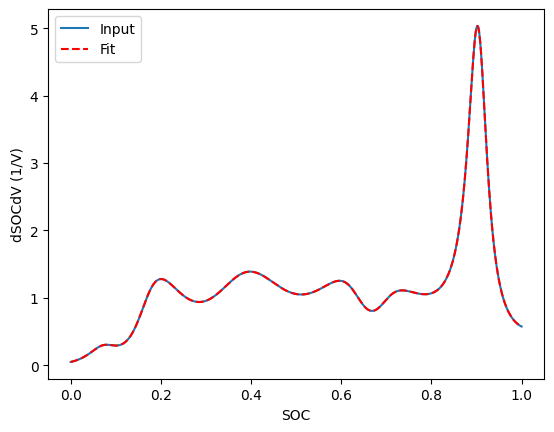
You can also fit to differentiated voltage data:
stoichiometry_limits, fitted_curve = dma.run_ocv_curve_fit(
    input_data=OCV_result,
    ocp_ne=neg_ocp,
    ocp_pe=pos_ocp,
    fitting_target="dQdV",
    optimizer="differential_evolution",
    optimizer_options={"bounds": [(0.8, 1), (0.2, 0.3), (0, 0.1), (0.86, 1)]},
)
print(stoichiometry_limits.data)

fig, ax = plt.subplots()
fitted_curve.plot(x="SOC", y="Input dSOCdV [1/V]", ax=ax, label="Input")
fitted_curve.plot(
    x="SOC",
    y="Fitted dSOCdV [1/V]",
    ax=ax,
    color="red",
    label="Fit",
    linestyle="--",
)
ax.set_ylabel("dSOCdV (1/V)")
shape: (1, 8)
┌────────────┬────────────┬────────────┬───────────┬───────────┬───────────┬───────────┬───────────┐
│ x_pe low   ┆ x_pe high  ┆ x_ne low   ┆ x_ne high ┆ Cell      ┆ Cathode   ┆ Anode     ┆ Li        │
│ SOC        ┆ SOC        ┆ SOC        ┆ SOC       ┆ Capacity  ┆ Capacity  ┆ Capacity  ┆ Inventory │
│ ---        ┆ ---        ┆ ---        ┆ ---       ┆ [Ah]      ┆ [Ah]      ┆ [Ah]      ┆ [Ah]      │
│ f64        ┆ f64        ┆ f64        ┆ f64       ┆ ---       ┆ ---       ┆ ---       ┆ ---       │
│            ┆            ┆            ┆           ┆ f64       ┆ f64       ┆ f64       ┆ f64       │
╞════════════╪════════════╪════════════╪═══════════╪═══════════╪═══════════╪═══════════╪═══════════╡
│ 0.849923   ┆ 0.270011   ┆ 0.030008   ┆ 0.900007  ┆ 5.0       ┆ 8.62199   ┆ 5.747131  ┆ 7.500488  │
└────────────┴────────────┴────────────┴───────────┴───────────┴───────────┴───────────┴───────────┘
Text(0, 0.5, 'dSOCdV (1/V)')
Chen CH, Planella FB, O’Regan K, Gastol D, Widanage WD, Kendrick E. Development of Experimental Techniques for Parameterization of Multi-scale Lithium-ion Battery Models. Journal of The Electrochemical Society. 2020;167(8): 080534. https://doi.org/10.1149/1945-7111/AB9050.